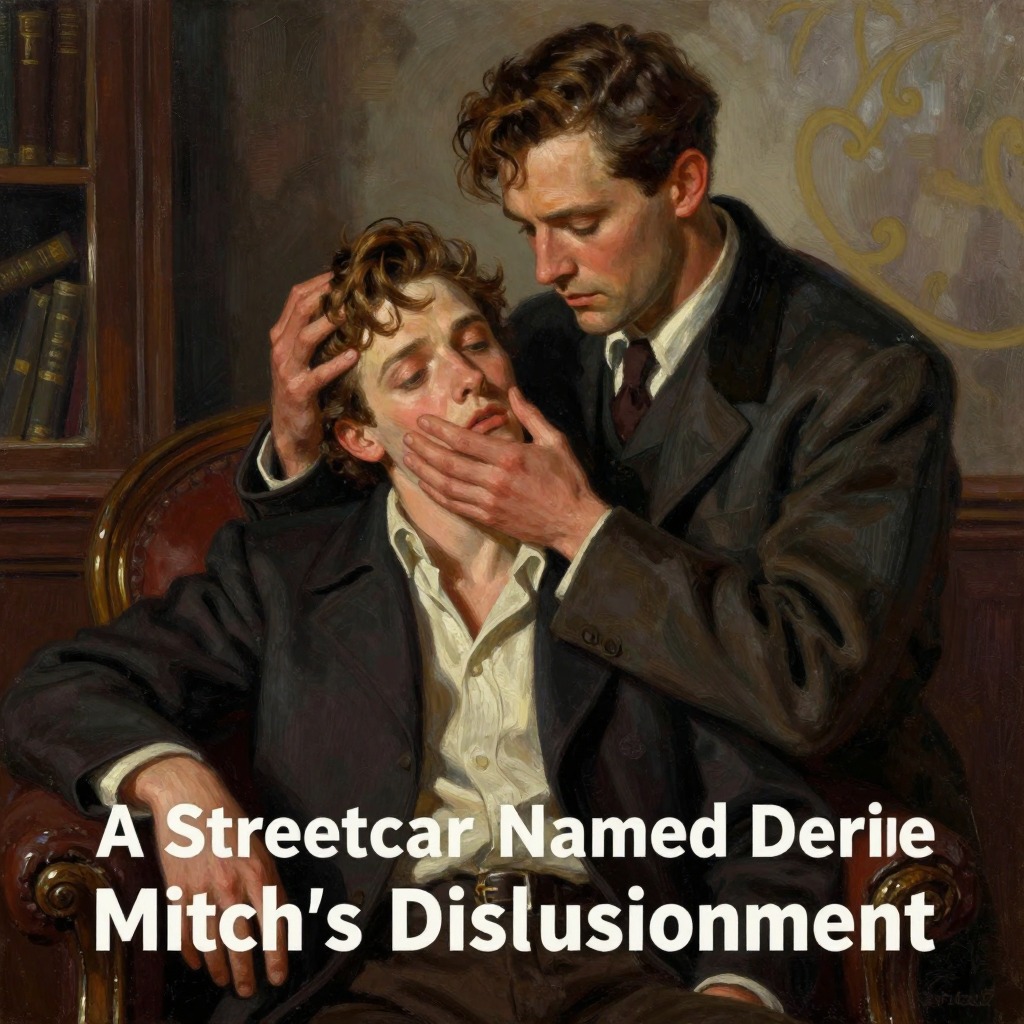
Mother-son relationship between Harold Mitchell's mother and Mitch
The mother-son relationship between Harold Mitchell (Mitch) and his mother is a quiet but powerful force in A Streetcar Named Desire, shaping his character, his hopes, and his capacity for both tenderness and cruelty. Mitch's mother is never named and never appears on stage, yet her presence—and her approaching death—governs nearly every significant decision he makes. She is the reason he hesitates to host poker games, the reason he seeks a wife, and ultimately the standard against which he measures Blanche DuBois and finds her wanting.
The Mother's Illness and Mitch's Devotion
Mitch's mother is gravely ill and not expected to live long. He speaks of her with a heavy, almost childlike devotion, explaining to Stanley during the poker night that he "gotta sick mother" who "don't go to sleep until I come in at night" . When Stanley mocks him, Mitch insists that his mother tells him to go out, but he cannot enjoy himself because "all the while I keep wondering how she is" . This constant worry is not a passing sentiment; it is the central fact of his emotional life. He tells Blanche that his mother "won't live long. Maybe just a few months" , and that she worries because he is "not settled" . His desire to marry is not ambition or romance but a final duty: "She wants me to be settled down before she—" . The sentence breaks off, but the meaning is clear—he wants to give his dying mother the peace of seeing him established before she goes.
The Mother as Moral Arbiter
Mitch's mother becomes the invisible judge of Blanche's worth. When he begins to court Blanche, he tells his mother about her, and his mother asks, "How old is Blanche?" . This question, relayed to Blanche during their intimate conversation in Scene Six, is the first crack in the romance. Mitch cannot answer, and the question hangs in the air, a signal that his mother's approval is a prerequisite for any serious relationship. Later, after Stanley has revealed Blanche's past, Mitch confronts her with the devastating verdict: "You're not clean enough to bring in the house with my mother" . The phrase is brutal in its specificity—not "I don't want to marry you" but "you're not clean enough to bring in the house with my mother." His mother's house is a sanctuary of purity and propriety, and Blanche, in Mitch's eyes, would defile it. The mother-son bond, which once seemed a source of gentle loyalty, becomes the instrument of Blanche's final rejection.
The Mother's Absence and Mitch's Loneliness
Mitch's devotion to his mother is also a measure of his profound loneliness. He tells the poker players, "You all are married. But I'll be alone when she goes" . This fear of being left utterly alone is what drives him toward Blanche. He confesses to her, "I need somebody, too. Could it be—you and me, Blanche?" . His need is genuine, but it is also conditional: he needs a woman who can replace his mother without contradicting the image of purity his mother represents. When Blanche fails that test, Mitch's loneliness hardens into bitterness. He does not simply walk away; he returns to her apartment in work clothes, unshaven, and tears the paper lantern off the light bulb, demanding to see her "good and plain" . The tenderness he once showed—the silver cigarette case inscribed with Elizabeth Barrett Browning's sonnet, the roses he brought—is replaced by a cold, almost punitive realism. His mother's impending death has left him desperate for a pure love, and when he cannot have it, he becomes cruel.
The Mother's Legacy in the Final Scene
In the play's final scene, as the Doctor and Matron come to take Blanche away, Mitch is present at the poker table but cannot look at her. He sits with his head down, staring at his hands . When Stanley taunts him, Mitch mutters, "You . . . you . . . you. . . . Brag . . . brag . . . bull . . . bull" , but he does not rise to defend Blanche. His mother's judgment has already been delivered, and he cannot override it. The mother-son relationship, which once promised to be a source of stability and love, ends as a barrier to compassion. Mitch is left with his dying mother, his loneliness, and the knowledge that he has rejected the one person who might have understood his need for kindness.